Everyone loves me, says Colbert. I am known, therefore I am. My life has meaning because everything I do is important, and known by other people. In heaven, everyone’s a celebrity.
Which is, oddly, my idea of hell.
This week J.D. Salinger died, a man who was the antithesis of the celebrity generation. In a recent appreciation of Salinger by his long-time friend Lillian Ross, I found the following:
The older and crankier he got, the more convinced he was that in the end all writers get pretty much what’s coming to them: the destructive praise and flattery, the killing attention and appreciation. The trouble with all of us, he believed, is that when we were young we never knew anybody who could or would tell us any of the penalties of making it in the world on the usual terms: “I don’t mean just the pretty obvious penalties, I mean the ones that are just about unnoticeable and that do really lasting damage, the kind the world doesn’t even think of as damage.” He talked about how easily writers could become vain, complaining that they got puffed up by the same “authorities” who approved putting monosodium glutamate in baby food.
This morning I stumbled to my computer to find this quote by Paul Brunton waiting for me: A humble life dedicated to a great purpose, becomes great.
Philosopher and mystic, Paul Brunton
On the back of one of his books, it says this: Paul Brunton (1898-1981) was a British philosopher, mystic, and traveler. He left a successful journalistic career to live among yogis, mystics, and holy men, and studied a wide variety of Eastern and Western esoteric teachings. With his entire life dedicated to an inward and spiritual quest, Brunton felt charged with the task of communicating his experiences to others and, as the first person to write accounts of what he learned in the East from a Western perspective, his works had a major influence on the spread of Eastern mysticism to the West.
I can’t help but wonder how the quality of literature, music, film, and life in general might not be improved if what we did in our public lives came solely (soul-ly?) from that sense of being ‘charged,’ or as some might name it, ‘answering a call?’ What if people stopped being interested or obsessed by what some person they don’t know is doing with this particular nano-second in their day, and more concerned with living humbly, in service to great purpose?
I wonder.
The anti-fame movement. Encouraged on this blog. You heard it here first. Snort. (Yes, I do get the irony, people, but I also think God loves a good belly-laugh.)
Now and then I get emails from writers who are also recovering alcoholics, asking me whether I found it difficult to write once I got sober.
I tell them I did, but then writing’s always difficult. If it was easy, everyone would be doing it (and although some days it feels like everyone IS writing a book, they really aren’t, and among those who are, few do it well).
They tell me they don’t know if they can write without the drugs or the booze, and fear they’ve lost their creative edge.
I tell them my own experience with those fears, and how the truth is that I never wrote anything worth publishing while I was drinking. I usually refer them to an essay I wrote for THE LITERARY REVIEW where I talk about my own struggle learning to write without the dubious assistance of mind-altering substances.
I got another one of those emails just this morning, from a woman whose writing I think is terrific. She was my student for a while and one of those who showed real talent. Now she’s been sober for a little over a year and she’s starting to feel as though life’s pretty boring without “my fiction worlds to swim around in.” She assures me she doesn’t want to drink over it, though. Absolutely, positively, not gonna drink. Nope. No drinking. Really.
I hope not.
For some people – those normal folks who don’t have a drinking problem – a glass of scotch next to the keyboard may in fact rev up the creative juices a bit. It might even do that if you ARE an alcoholic. Briefly. But if you’ve got the addictive gene it will turn on you. That’s a promise. It will wipe out your ability to write. That is, as Tom Waits once said, “the thistle in the kiss.”
I came across a quote this morning from the Sufi master Pir Vilayat Inayat Khan. He said: ”To bring the sublime into the mundane is the greatest challenge there is.” The same might also be said about writing. The same might also be said about sobriety.
Both writing and sobriety are journeys; they are not destinations. I have a friend who took a trip to the Tunisian desert, where he walked for several weeks. That’s it. He just walked. One foot in front of the other across the sands. He said the first day was sort of exciting. The next day was disappointing. The third was annoying. The fourth he wanted to get the hell out of there. The fifth he thought he’d die. The seventh he cried. And then something happened. He began, to metaphorically drop things in the sand behind him. Things he didn’t need. The annoyance, the irritation, the desire for something to ‘happen,’ old memories, resentments, desires, the need for control. It was just him, and the desert – all that space and wind and sky and ever-shifting sand. He felt no need to arrive anywhere, and lost his sense of having come from somewhere else. The desert simply was the desert and he was simply there. He began to notice things he’d never noticed before. A lizard. A small desert plant. A shadow. A rock. A cloud. A particular shade of blue, or ochre. Everything came alive and was, he said, holy, worthy of attention and gratitude.
Each day we sit in front of a blank page, each word we follow with another, each moment and mundane detail we honor with our attention, is another step across the desert sands. This is one of the things writing has taught me. This is one of the things sobriety has taught me.
It’s been a difficult week. The Best Beloved and I just got back Montreal where we’d gone for my father-in-law’s funeral. Morris passed away on January 12th (which is, oddly, also the day on which my adoptive father passed away, back in 1993). My father-in-law, Morris, was a great guy. He owned a department store in Saint Georges de Beauce near Quebec City, a store that was the heart of the region. He had friends right out of Damon Runyon with names like Joey Onions, Jimmy-the-Book, Big Phil,and Jack-the-Hook, among others. He liked to hang out at the track. Loved the ponies and, when he went to Florida every winter, loved the greyhounds, too. Sitting in Ben’s Smoked Meat on Boulevard de Maisonneuve in Montreal at 1:00 a.m., with Morris sipping his 20th cup of coffee that day was like was like walking into a Mordecai Richler novel. He knew all the insomniacs and gypsy hacks, as Tom Waits might say. He knew the waiters. He knew the salesmen. When he and my adopted father first met, they got into a conversation about Rockhead’s Paradise, arguably the best jazz night club Montreal ever saw. His funeral was packed with people, who all remembered him as a guy who might not have talked much, but who made everyone feel comfortable. He helped before you had to ask him, and made everyone feel like an equal – from the street cleaner to the business executive. That’s a rare talent.
His partner, Louisette, told me she came out of the bedroom a few months ago and found Morris crying. When she asked him what was wrong he said, “Nothing, nothing,” and disappeared into the bathroom for a few minutes. When he came out he simply said, “I’ve had a nice life.” And that was that. He may have been a man of few words, but he chose the right ones.
On the day we were leaving a friend of mine, who I’ll call Joe, came to see me at the hotel where we were staying. I’ve known Joe for probably ten years, and I love him to bits. He’s kind and thoughtful and smart and funny and creative as hell. And he, like me, is a recovering alcoholic/addict. We both got clean and sober about fifteen years ago. Joe’s been through a rough time the past few years with professional issues and loneliness (which I can’t figure out since he’s all the things I said above, plus gorgeous). And although things look like they may be turning around, it’s still not easy. He looks great though, and I said so.
Ah, he said. Well, I’ve lost some weight.
How’d you do it? I said (since I’ve packed on a few pounds myself).
I started smoking again, he said.
Oh, no! That’s not a good idea.
No. And I’ve started drinking again, too.
He looked as though he was afraid I might send him to detention. But the truth was I wasn’t completely stunned. I saw Joe about a year ago, and he’d been complaining about not liking those meetings in church basements we go to. They brought him down, he said. I said, You don’t have to like them; if you want to stay sober you just have to go. He didn’t have a sponsor any more, either, and wasn’t helping other people stay sober.
So, I guess he didn’t want to stay sober. That’s the bottom line, isn’t it? He hurt and he didn’t want to hurt anymore and although he said his spiritual life was fine, that he still had a relationship with whatever he understood to be “God,” he didn’t seem to have much serenity. Somehow he thought taking a drink would stop the hurt.
But as I see it, now he only has something else to worry about. Will he be able to control his drinking? Because he is ‘managing’ it, as he puts it. (Frankly My Best Beloved, who doesn’t have this whole addiction thing, has never ‘managed’ a drink in his life. Doesn’t even think about it. That’s how non-alcoholics think, which I grant you, from the perspective of a real drunk like me, is BIZARRE.) Now that he’s started drinking, and admits to having had a joint, is he going to find himself back doing other ‘dry goods’ as well? If he’s got money problems, where’s the money for booze going to come from?
He says he’s not drinking every day, but there’s booze in the house, and he admits to drinking at least every couple of days.
“I know how this sounds, but it’s not a problem,” he says.
Maybe he’s right. Maybe he’s the one in a thousand who can drink safely again. I sure hope so. But the fact that he’s willing to experiment with something that once tried to kill him doesn’t seem sane to me. Sure, maybe after all these years of sobriety I could start drinking like normal people again, but if I can’t, I’ll die a wretched death, or end up in jail, or a mental institution. That kind of Russian roulette doesn’t interest me.
But watching a friend walk straight into a railroad tunnel, toward that nice bright light, is a horrible feeling. I feel helpless and frightened and terribly sad. So, having developed some healthy habits over the past 15 years, as soon as I got back home I went to one of those church basement meetings. In the meeting they talked about the difference between what we want and what we need. One man talked about his mum, and how she had endured three terrible bouts with breast cancer. The last one finally killed her. She hung in there until Christmas day, which was her favorite time of year, and died, at peace, looking up at the Christmas tree. Like my father-in-law she never complained. A few weeks before she passed, her son asked her how she was able to bear the pain and the grief – wasn’t she angry, wasn’t she resentful? A woman filled with faith, she smiled, patted his hand, and said, “I’m fine. This is where God has me right now.”
That got me. My father-in-law wasn’t religious, but he had that same sort of acceptance, that same sort of gratitude for his life and the circumstances of his present moment, whatever they might be. Acceptance doesn’t mean we don’t feel grief, or anger or regret, or even agony. It does mean we just feel it, knowing it to be part of the experience of life. Part of the human experience, equalizing, inescapable, mysterious.
The next time I am crippled by pain, either physical or emotional, rather than reaching for a drink or a drug to numb the pain, I hope I will remember the words of my father-in-law, and that man’s mother: “This is where God has me right now. I’ve had a nice life.” Acceptance and gratitude – the best medicine.
I wonder how many of you have asked a writer of your acquaintance what you thought was a perfectly harmless question, one intended to show your interest in that person and what they do, only to be rewarded by a mumbled response, possibly a trembling chin, or, horrors, a glower. You walk away thinking, What’s wrong with these writer people? Have they no manners? Well, sadly, some of us don’t, but it’s more likely you’ve stumbled upon one of the questions likely to leave us at…well, a loss for words.
I don’t mean to suggest that writers are such fragile flowers that no one should approach us for fear of having us break down in puddles if asked the wrong question. Really, that hardly ever happens. But if you do detect a slight twitch, or an inadvertent sigh, perhaps it’s because you’ve asked a perfectly well-meaning, seemingly reasonable question, one that if you asked anyone else wouldn’t be a problem. However, as writers, alas, we’ve probably been asked that question a thousand times before, and wouldn’t mind at all, if we had a decent answer, but we don’t, and so we mumble and sigh and twitch and go and stand behind the potted palm where it’s safer. It’s embarrassing to stand there with a drink in one hand and a palm frond up the nose. Uncomfortable for everyone, really.
So, for next time…these are some questions writers dread, in no particular order:
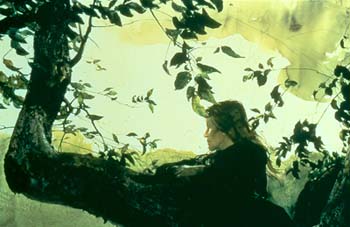
1. How’s the novel coming? Well, probably not very well. Novels are wild, unwieldy beasts that resist being tamed. Really, do you want to hear how Faulkner spent twelve hours writing a scene about looking at young girl’s dirty underpants as she climbed a tree? Probably not, and that was the definitive scene in The Sound and the Fury, so imagine how much less you’ll want to read about that eel-skinning scene I labored over for hours yesterday, only to erase today. To quote Oscar Wilde, “I was working on the proof of one of my poems all the morning, and took out a comma. In the afternoon I put it back again.”
There is also a story about James Joyce wherein someone came round to see The Great Man as he worked in his Paris garret
“How are you, James?” he said. “You don’t look so good.”
“I’m terrible.”
“Is it the writing?”
“Of course it’s the feckin’ writing! It’s always the writing!”
“Can you not write then? Are you blocked?”
“I’ve written seven words today.”
“Well, James,” said the friend, “for you, actually, that’s not bad.”
“I suppose,” said the Great Man, “but now I’ve got to figure out what order to put them in.”
Thus, it’s a question for which there is no good answer, and we know it.
2. Are you writing? If I am, see 1. above. If ‘m not, you really don’t want to know. The only thing worse than having writer’s block is talking about it. Having to listen to such panicked whining is recognized as torture and we wouldn’t dream of inflicting it on you.
3. Has your novel sold? Sad to say, but it’s unlikely. Publishing is a slaughterhouse these days, and even in the Good Old Days (if ever there were any), almost no one published, and of the minuscule number who did, almost none of those published a second novel. Having to answer that question over and over again is like rubbing glass in an open wound. Believe me, if there’s good news, we’ll be telling you. Heck, we’ll be telling EVERYONE! Most of us write because we can’t stop writing – it’s a sort of mental illness – and thus we do so in spite of the searing disappointments. Try not to make us talk about it.
4. When’s that new book coming out? Let’s put it this way: if, since the last time we spoke, I’ve finished the manuscript, submitted it to my agent, my agent has read it (which usually takes three months because they are busy, important folks), and loved it just as it is with no changes at all; if the agent has then in turn submitted it to editors and one of them has read it (think another few months or so, or more, since editors are also important, busy folks), and that editor LOVED it, and showed it to the sales force (the important people who really run publishing these days) and the sales force LOVED it just as it is, and made an offer……. even if ALL those things have already happened, it will still be around TWO YEARS before the book will actually come out, due to the editing and production process. So, if you’ve asked this question once in the past three years, you needn’t ask it again. Also, see 3).
5. I just love the new Dan Brown novel (or Sarah Palin’s memoir), have you read it yet? My condolences, and no.
6. How come I can’t get your books here? And by ‘here’ you probably mean America. This one may not apply to all writers, but it will to a surprising number of us. Especially if we are, say, from Canada or Britain or Ireland or Scotland or New Zealand or Australia… doubly so if we are from a country where English isn’t the first language (and no jokes about Scotland, please). Although, with some justification, America views itself as the center of the universe, people do publish in other countries, and getting published in England does not mean a writer will find a publisher in New York, which considers itself (again, with some justification) as the center of the center of the universe. Without a publishing contract in the US, the book will not be available to the US market. You could, however, go on the internet and order books from bookstores in the US or Canada or gasp, even Australia. I do it all the time.
7. Is that story autobiographical? Until my parents are all dead, the answer to that is no. I’m joking, really Mum, I am. However, it can be a bit insulting to a writer to have everyone think that a) you really were a junkie porn star homicidal trust fund baby and just kept it a secret, or that b) you haven’t the imagination to MAKE THINGS UP, which is, after all, what fiction writers are supposed to do, mostly. I will paraphrase what W. Somerset Maugham said, though, in that writers are not God, we cannot create out of nothing. Everything is inspiration and fodder, even cocktail party conversations.
8. Oh, you’re a writer! Have I heard of you? Do I know your books? I have no idea, but if not please don’t make it sound as if I’ve failed. Might I suggest, if you’re interested, you note one of the titles and buy a book?
9. How big an advance did you get?How many books did you sell? Now really, didn’t your mother ever tell you it was impolite to ask someone what they make for a living? It will either be shockingly low by your standards, or shockingly high, neither of which is useful information. People in France, where I lived for many years, never ask these sorts of particularly American questions. They ask instead, “Where can I buy one of your books?” Which is a lovely question, since it implies they are a) interested in your work, and b) interested in supporting your work by actually BUYING a book.
10. What’s the book you’re working on about? Two problems with this question: the first is that if I talk too much about it, I won’t write about it, so I don’t mean to be rude, but I don’t want to answer that question. (Most people are pretty good about that and don’t take offense, but you’d be surprised, perhaps, by how many do.) The second problem is that I may not know. I write a story that pops into my head, but I may not know what it’s really about until a long way down the line. When I was writing The Radiant City, it wasn’t until I was through the first draft, and heard Rev. Ernest Hunt, the Rector at the American Cathedral in Paris, say, “Cynicism is the last refuge of the broken-hearted” that I understood I was writing about precisely that – whether disillusionment, the kind that breaks your heart, like terrorist attacks, or war, or genocide, damns you to a life of cynicism, or if it’s possible to continue to walk through the world with a compassionate heart. (The quote became the epigram of the book. Thanks Ernie!)
And although it’s not a question, there is one statement that’s almost guaranteed to send a writer scrambling to a safe nest behind the potted palm: “I’m going to take six months off from my job and write a book.”
Legend has it this statement was made to either William Styron or Margaret Lawrence, depending on who’s telling it, by a heart surgeon at a cocktail party. As in, “I just loved your book so much, and you’ve inspired me. I’m going to take six months off from my job and write my own memoir.” “Really,” replied William/Margaret. “Well, you’ve inspired me as well. I’m going to take six months off from writing and become a heart surgeon.”
I wouldn’t have the guts to say that, but I admit it, I do think it from time to time. It takes as long to learn to be a good writer as it does to do anything else – play the violin, perhaps, or architecture, or yes, heart surgery. And just like those things, having just a soupcon of talent doesn’t hurt.
So at this point you might be asking yourself what you CAN ask a writer. Well, we love talking about books we’ve enjoyed, as well as anything else that inspires us. And as writers we tend to watch the world pretty closely, since you never know when a story worth writing about may pop up, so current affairs are just as interesting to us as to anyone else. Then too, if we’re well-brought up, psychologically stable folk (and some of us are), we probably think YOU’RE pretty interesting. You might not want to answer questions about, say, how much you make for a living, and I wouldn’t dream of asking you, but I’d be fascinated to learn, for example, what you believe and how you came to believe it. I’d like to know how you met your spouse, and what you think about the death penalty, and why; and what you think about censorship, and that story about fly-fishing, and the one about the rescue dog, and what you think it means to be a good person… oh, there’s a world of things out there to talk about, isn’t there?
I will leave you with this video, from the brilliant Family Guy. Poor Brian. I know how he feels.
Yesterday I had to make a plot decision in the novel I’m working on. This is something that happens frequently…all the time, in fact. Should a character wander off into the woods? Or should she climb the mountain? Should she open the door? Should he knock again? Kick it down? Should he walk away?
Credibility is, of course, an issue. Knowing young Jane, say, as I do, am I convinced is it in her nature to finally get off the couch and enroll in university, or is she more likely to dream about a bigger life, but never get past the television remote control? After spending all this time with Joe, do I believe he would finally walk into that AA meeting and get sober, or is he more likely to say to heck with all those freaks and take a long pull from his bottle of Jack, consequences be damned?
If I’m writing about a devout and mentally stable nun, who suddenly, for no reason at all, picks up a butcher knife and starts hacking away at the statue of Christ, well, readers are going to be puzzled, to say the least. In real life, we may say we never saw it (whatever ‘it’ is) coming, that why so-and-so did such-and-such is a complete mystery, but in fiction, our readers need to see a clue, some hint, a bit of foreshadowing for an action or a plot twist to make sense.
Then again, the paths along which I’ll guide my characters have to do with the themes I’m exploring. If I’m writing a book exploring how people never seem able to transcend their personality defects, then perhaps Jane stays on the couch, and Joe gets bombed. If I’m writing a book about hope and transformation, then perhaps things go differently. Or, perhaps it’s a combination of the two. I might hope my character will get sober, or educate herself, but if the characters I’ve created simply aren’t up to the task, are in fact too crippled by their neuroses and fears, then I either have to go back and create new characters, or I have to write the story as it presents itself, through the characters I’ve created.
That’s where Chekhov’s admonition to writers to properly ask questions, but not to try and answer them comes in. Sometimes when I get to the end of a short story or a novel the conclusions I draw from the events contained therein are not the ones I thought I’d draw when I started writing. That’s quite a magical moment — because, through the act of creating a world and the people who inhabit it, I’ve learned something new. I think sometimes that’s what drives me to continue writing.
I am fascinated by a concept in quantum physics known as the “many-world” or “multiple universes” or “multiverse” theory — in which there are an infinite number of universes, and everything that could possibly happen occurs in some universe. All possible universes exist simultaneously, regardless of what happens in any of them. Of course, I suspect, being a bear of very little brain, I haven’t the foggiest notion of what scientists like Robert Lanza are REALLY talking about, but I do quite like the concept that all the possible paths I might have walked, had I chosen that path over this one, this door over that, are still continuing, with me on them, more or less happily.
There is, after all, a kind of eternity in that concept. In a recent blog on death, Lanza says:
Death does not exist in a timeless, spaceless world. In the end, even Einstein admitted, “Now Besso” (an old friend) “has departed from this strange world a little ahead of me. That means nothing. People like us…know that the distinction between past, present, and future is only a stubbornly persistent illusion.” Immortality doesn’t mean a perpetual existence in time without end, but rather resides outside of time altogether.
I understand this best when I think of my fictional characters. When I was working on my last novel, in the first draft no one died. Okay, maybe it wasn’t happily-every-after, but at least everyone made it to the last page still breathing. Sadly, the draft didn’t quite work. I resisted it, but every solution pointed to the fact someone had to die, and I knew who — a character of whom I’d grown extremely fond. I did not want this to happen. I tried very hard not to let it happen. I worked for weeks and weeks, trying to find another way to arrive at the place I knew was right for the novel, credible for the plot and the characters; in short, trying to keep him alive. Finally, I surrendered to the inevitable. My beloved character met his destiny.
My characters, once I’ve created them, are real to me. They exist, perhaps not in the sense this table exists, or my Best Beloved exists, but in a garden of my soul, they are alive. I think about them often, as I would friends-and-relations, some more often, some less, but all are contained within my psyche. And what happens, then, when I struggle so with a decision for one of them? Well, I see myriad paths, each one leading to a different conclusion, to a different set of possibilities. And regardless of which one finally ‘wins’ for the sake of the novel, the others do not cease to be, just as the characters do not cease to exist for me when I put the final period on the sentence. That character who ‘died’ on the page, is still alive, outside of time and space, just as surely as if I had written a different end for him, and perhaps, dare I say, as real to me as others I haven’t ’seen’ for a long time.
When I take a few moments to sit still and look out this window at the horizon where sea meets sky, I cannot help but contemplate what lives there, just out of sight, just beyond the range of my limited vision. In his excellent book, Eternal Echoes, poet and philosopher John O’Donoghue says,
You know your real life is happening here. Yet your longing for the invisible is never stilled. There is always some magnet that draws your eyes to the horizon or invites you to explore behind things and seek out the concealed depths. You know that the real nature of things is hidden deep within them. When you enter the world, you come to live on the threshold between the visible and the invisible. This tension infuses your life with longing. Now you belong fully neither to the visible nor to the invisible. This is precisely what kindles and rekindles all your longing and your hunger to belong. You are both artist and pilgrim of the threshold.
Pilgrim of the threshold. I can’t think of a lovelier way to describe a writer.And I do love it when art and science and faith all converge, don’t you?
The sad fact is that I read more mediocre, or even bad books, than I do good books; so when I read a terrific book I can’t help but want to pass along a recommendation. So here it is: get out there and order a copy of Amy Bloom’s new collection of short stories, Where the God of Love Hangs Out, which will be in stores January 2010.
Bloom, who worked as a psychotherapist for twenty years, has an uncanny ability to expose the psychological realities of her characters. More than once I found myself thinking of a clinically trained Henry James, and I mean that as a compliment. The focus is intimate, sensual, unflinching while deeply compassionate. I am embarrassed to admit this is the first thing I’ve read by Bloom, but it won’t be the last. I’ve now added her novel Away, and another collection of short stories, A Blind Man Can See How Much I love You, to my list. I can’t imagine where I’ve been, frankly, since Ms. Bloom has been the recipient of much acclaim, including National Book Award nominations, and National Book Critics Circle Award nominations as well as any number of reviews like the one from The New Yorker, for A Blind Man Can See How Much I Love You, which states, “Amy Bloom gets more meaning into individual sentences than most authors manage in whole books.”
In this collection, Bloom examines the many forms of love. Two sets of linked stories, which are really novellas, sit at the book’s core. Both are concerned with a different set of unlikely couples. One, the stories of “William and Clare,”begins with Clare and William falling into an affair that survives their respective divorces, their own marriage and the frailties and vulnerabilities of the end of life. The second set features Lionel and Julia, step-mother and son — it’s a messy, complicated story that had me wincing with discomfort more than once, but that managed to keep me glued to the page right through to the remarkable and moving conclusion. The four independent stories, while less intricate, are lovely as well. Astute, clear, insightful work all the way through.
An odd thing to say perhaps, but I’m a little surprised the stories work as well as they do since Bloom does what I constantly advise my writing students to avoid (and OH! how I’m going to hear about this in class!). She switches point of view at a somewhat alarming rate, particularly for the short story form. We move from one characters’ perspective to another, sometimes from one paragraph to the next, and more than once I found myself thinking, “What? Who’s thinking this? Who’s head am I in?” And having to go back a sentence or two to adjust. If Bloom established an omniscient point of view at the beginning of a story it would make these transitions more graceful, but she doesn’t. Rather each story begins with rather close-up psychological distance in a limited third person point of view. Thus, I get comfortable there, and except to stay in that point of view, with minor alterations to the psychological distance. It’s a bit jarring to suddenly pop into another character’s head.
Still,the confidence of Bloom’s prose, her flawless dialogue, and the authority with which she creates these characters’ worlds, both internal and external, more than make up for my point of view quibbles. I was much reminded of Elizabeth Stout’s wonderful Olive Kitteridge. Comparisons to Alice Munro’s work are also inevitable.
And Bloom has a fabulous way with an opening sentence. Consider these:
From the William and Clare series: “At two o’clock in the morning, no one is to blame.” “William has gout.”"Clare can’t walk.” “No power.”
From the stand-alone stories: “I had always planned to kill my father.” “Terrible is terrible, Frances thought.” “Every death is violent.”
From the Lionel and Julia stories: “I was born smart and had been lucky my whole life, so I didn’t even know that what I thought was careful planning was nothing more than being in the right place at the right time, missing an avalanche I didn’t even hear.” “For fifteen years, I saw my stepmother only in my dreams.” “‘It’s six-fifteen,’ Lionel says to his stepmother. ‘Decent people have started drinking.’”
I sometimes suggest my writing students keep lists of possible first sentences. I’ll use these Bloom’s work as examples of why.
Bloom has said her favorite poet is Wislawa Szymborska whose poems often raise ethical and existential questions, and I suspect Bloom might claim Chekhov as one of her influences for the short story form, if asked. There is something of Chekhov’s open endings, his refusal to moralize, and his insistence that the writer should ask questions, not answer them that resonate here.
Read, enjoy…come to your own conclusions about where the god of love hangs out.
In the last week I’ve had a couple of interesting conversations.
I was at a book launch for a poetry collection last week. I won’t name the poet, since I fear my words might offend him, and I am uncomfortable offending folks. The organizer had arranged a panel discussion between poets and scientists, to discuss where the intersection set between them might lie. Someone in the audience asked about intuition and one of the scientists, who was also a professor, said he aimed to foster intuition in his students, and did so by training them in knowledge, since he believed a solid knowledge base was the fertile field of intuition.
I liked that, since my experience with writing has been just that — my ability to intuit what’s best for my characters and my plots, why this word works better than that one, springs from years of training. So I said so. I said that what the scientist/professor told his mathematics students is precisely what I tell my writing students.Practice, learn your craft, train your mind to observe the world as a writer so that when intuition breaks forth, you can recognize it and you know what to do with it.
Well, the poet didn’t like that. He jumped in, bristling, and said that training was the death of art and no artist should train (a word he spit through his teeth like a bad seed). All art, he said, was purely experiential and there was no room for such stultifying processes as training. He then went on to talk about seeing in “hyper-space” and how when he was thus transformed one eye looked into the “other realm” and one stayed focused on this world. He said you could see it, if you watched him on film.
I’m afraid he rather lost me there, and all I could think of was how when My Best Beloved gets tried, his left eye wanders. A bit lazy that eye, and its wandering is how I know it’s time for sleep. Nothing to do with “hyper-space” whatever the poet meant by that. However, I kept mum, since the poet seemed mightily grumpy on this subject and hadn’t asked my opinion anyway. Nor did I mention my impression that his poetry, frankly, could have benefited from a wee bit of training. (I suspect he’d think my prose would benefit from a wee bit less.)
So, that was one conversation.
The other occurred when My Best Beloved and I were in New York City over the weekend, and had lunch with my old friend, Ted Quinlan, and his partner Sandy. Ted is probably Canada’s foremost jazz guitarist (or Guitar God, as my 18-year-old godson calls him), and certainly someone who has trained in his art for decades.
We had a fantastic lunch at The Boathouse in Central Park, which has got to be one of my favorite spots in the city. The scallops, I must say, were the sweetest I’ve ever eaten. We sat at a white-clothed table right next to the floor-to-ceiling windows and gazed out on the semi-frozen lake, the boats (upturned for winter), the great granite rocks and leaf-barren trees . The rain pelted down and over lunch the ice turned to mush and then slate-ish water.
Since Ted and Sandy are Canadians here for a sabbatical year, we talked about what differences they’d noticed between Canadians and Americans. Naturally, we talked about health care, and agreed none of us could understand why so many Americans don’t see this as a human rights issue, and why they don’t seem to want everyone in their country to have at least basic health care. Mystifying. And then the talk turned to the news, or what passes as news in the US.
We talked about the crazy coverage of things like Tiger Woods marital problems, and the frantic, fear-mongering on some television and radio stations, and how unlike news coverage anywhere else in the world it is. Ted mentioned the whole “Balloon-Boy” fiasco and how Americans are fixated on these sensational stories.
“They even broke into regular programing for these updates,” Ted said. “It became one of those moments people will talk about later– ‘do you remember where you were when the Balloon Boy story broke?’ Like the OJ story years ago.”
And we talked about that, about how when reporters like Christiane Amanpour were desperately yelling for people to turn their attention to the genocide in Rwanda, no one could hear them over the roar of the OJ story. Tragic.
Ted recalled how he remembered exactly where he was when the OJ story broke. He was on stage in a club that had the television tuned to an American station and there was that now-famous white Bronco, heading up the highway, with millions of people watching.
Ted said, “And what’s weird is that although I remember the story so clearly, I don’t remember who was on stage with me, or whose gig it was. I just remember that image of OJ in the Bronco.” He shook his head. “I later figured it out. I was talking with my friend Mike, about how he didn’t remember who he was with, either. Putting the pieces together we discovered we were in the same place, playing together.” He blinked a couple of times and said. “I don’t know what that means… you know… but there it is.”
I thought about it for a moment and said, “Well, I think it means that the danger of a society saturated with these sensational stories is that it keeps your attention riveted to the screen, and away from what’s really important, what’s actually happening in your own life; it’s a kind of distraction drug — look over here! look over here! Don’t look at the important thing happening right in front of you! Look over here!”
Ted burst out laughing and said, “There you go! If you want to find meaning in something, ask a writer! That is your job, after all, isn’t it?”
What a lovely thing to say. Because that’s in fact what I believe my job is: to make meaning from our lives, our experience, our stories.
Now, I’m no smarter than Ted or Sandy or My Best Beloved. In fact, I might be far less intelligent than they are. But because I’ve trained my mind for years to look at things like narrative arc and symbolism and metaphor and so forth, it’s easier for me, in circumstances like this where stories are being told, to grasp onto an intuitive flash. That, in turn, permits me to craft meaning from experience.
It’s limited, of course. I get no intuitive flashes about say, engineering, or particle physics, or astronomy. Not that I wouldn’t love to… but that’s just not where my training lies.
So, with all due respect to the unnamed poet, I’m afraid I have to disagree. Training is important in any arena where one hopes to do well, from auto-racing to brain surgery to playing the jazz guitar, or to writing. I’ve said it before and I’ll say it again… writing is a practice, a way of living, and as such it requires attention, dedication, and yes, training. We train so that, when the intuitive flash arrives, we’ll know what to do with it, how to take it and form it into meaning; so we’ll have the appropriate tools at our fingertips, and the knowledge of how to use them. You just don’t get that by happenstance; it is a gift earned by attention and intent.
Intuition may well be an act of grace, which comes upon us unmerited, but in order to make use of its gifts for a purpose perhaps greater than my own mere pleasure, I need to train my skills, hone my abilities, and be humble enough to know it.
Vita Sackville-West's writing desk in Sissinghurst Tower
It is necessary to write, if the days are not to slip emptily by. How else, indeed, to clap the net over the butterfly of the moment? For the moment passes, it is forgotten; the mood is gone; life itself is gone. That is where the writer scores over his fellows: he catches the changes of his mind on the hop. ~Vita Sackville-West
Some writers have tricks for getting themselves into the ‘mood’ to write – like leaving yesterday’s work mid-sentence, so at least there’s a few words to begin with. I do that myself, and I start every new writing day by reading over what I wrote the day before, editing, adding and erasing until, without realizing it, I’m past the point at which I stopped the day before.
But I think preparing to write is something a writer must do at all times, not merely when approaching the desk. The challenge is a constant one, not restricted to the moment when fingers meet keyboard. Being a writer is, for me at least, a state of mind, a way of looking at the world, a practice if you will. And it’s about more than writing. It’s a way of experiencing the world and making meaning of it.
In January, 2010 I’ll be teaching a course on “Creating Character Emotion” as part of my gig as Writer-in-Residence at Trinity Church, Princeton. Most emerging writers think writing sentences such as, “Amy was gleeful!” or “Bob despaired” constitutes writing emotion, but such writing does little to actually create the desired emotion in the reader, which is what a writer tries to do.
When I sent my friend Cliff Moore, Publisher of the Montgomery News, a press release about the upcoming course, he wrote back and said, “I just use emoticons.” Snort. I love Cliff. He obviously meant this as a joke, but I’ve read some prose that might have been improved by emoticons.
As writers, one of our jobs, and one of the gifts of the profession, is to spend time observing and considering our own emotional states, and those of others. We need to understand emotion, because we are trying to produce in our readers the very emotions our characters experience. That’s how readers become part of the waking dream that is reading: by experiencing the emotions, not by thinking about them. Thus, we cannot take shortcuts like unsatisfactory declarative sentences such as, “He was confused. She was angry. Oh, how happy she felt.” Rather, we must examine emotions, understand how they work and how they manifest themselves in our bodies, our responses, our minds, so that we can reproduce them.
We must become, in short, aware – “clapping the net over the butterfly of the moment” as Sackville-West said.
Vladimir Vladimirovich Nabokov (author of "Lolita") with his net.
Take note the next time someone near you is furious – what do they look like? What color is her skin? How do his eyes look – do they narrow or widen? What does he do with his hands? What does she do with her lips? Does her speech patterns change, becoming either more staccato, or more rambling than usual? In other words, how do you know he or she is furious? What’s the ‘tell,’ as gamblers and con men call it, the involuntary gesture or expression that reveals what’s going on behind the masks we all try and wear? Capture that, and learn to describe it properly, without cliche, and you’ll be on your way as a writer.
Take note the next time you’re feeling lonely, for example, or filled with regret, or embarrassed. What’s happening inside you? What physical sensations are occurring? Look at yourself in the mirror? What do you see?
Start now… try this exercise — write a paragraph – 3rd person (he/she) - describing someone you know in such a way that the reader will know what the person is feeling. Don’t name the emotion, and don’t use dialogue. Stay with what you can observe at a distance. Stay moment-to-moment, showing the reader gestures and ticks, micro-expressions, fidgets,
Now, try the same exercise, this time in the 1st person (I), and use some thoughts and internal physical responses along with the gestures, etc. Perhaps a brief memory-flash, or a quick projection into the future?
Finally, rather than simply naming an emotion like loneliness, what might symbolize it? Consider the multiple Baggies in this example:
At the movie – DEATH BY NUMBER – she bought strands of red licorice to tug and chew. She took a seat off to one side in the theatre. She felt strangely self-conscious sitting alone, and hoped for the place to darken fast. When it did, and the coming attractions came on ,she reached inside her purse for her glasses. They were in a Baggie. Her Kleenex was also in a Baggie. So were her pen and her aspirin and her mints. Everything was in Baggies. This was what she’d become: a woman alone at the movies with everything in Baggies.
- Lorrie Moore, YOU’RE UGLY, TOO (Granta Book of the American Short Story)
Okay, it’s true, Moore does say the character “felt strangely self-conscious sitting alone.” I would suggest that’s almost permissible since the emotion contained in the sub-text (what’s not said) is loneliness rather than self-consciousness.. Still, a gesture rather than the declarative might have made the passage even stronger, or it might even have been removed, leaving only the desire for “the place to darken fast.” That implies self-consciousness perfectly, as does the specifically chosen seat off to one side. We get the idea, Moore needn’t have told us. (One of the nice bits of this passage, by the way, is that the character’s self-awareness and the humor regarding the Baggie image help avoid a feeling of self-pity.)
When you’ve practiced these kinds of observations for a while I think you’ll discover one of the other gifts of living your life as a writer — increased empathy.
An example: I knew a woman who had a mental illness. As a result of that illness, she was often horribly cruel, blurting out things designed to cut deeply enough to leave scars. Then, one day, when I was trying to writer about her, I remembered a gesture she frequently made: after she’d said something that brought tears to my eyes, she gave an infinitesimal shake of her head and pressed her lips together. I was just a child when I first saw those gestures, but as an adult writer, I recalled them, and considered them. In a flash I understood that this woman, this poor woman, never wanted to say the things she’d said. She wanted, I suspect, to be a different person entirely, a person free from the hideous isolation of her illness. She raged, albeit silently, as much against herself as anyone else. And in that moment I was filled with enormous compassion for her, and was able to write about her in a way that made her not only interesting to others, but also sympathetic. (The character is Margaret, in The Stubborn Season.).
Writing became such a process of discovery that I couldn’t wait to get to work in the morning: I wanted to know what I was going to say. ~Sharon O’Brien
That wonderful process of discovery that O’Brien refers to makes the world, and our place in it, a far more interesting and meaningful place. Our focus becomes more outward, paradoxically enough. We use writing as a way of clapping our nets over one moment after another, and take the time to examine them, to honor them with our attention.
A SLIGHTLY DIFFERENT VERSION OF THIS ARTICLE WAS FIRST PUBLISHED IN THE GLOBE & MAIL:
In the New York Times recently, there was a review of a new memoir which is probably going to cause some controversy — Julie Myerson’s Lost Child: A Mother’s Story. In case you missed the firestorm in England when this book was first published there, the reviewer tells us that Ms. Myerson was “pilloried in her home country this spring as cruel, selfish and manipulative for writing about her teenage son’s descent into drug addiction.” Ms. Myersons’s son, Jake, the subject of the book, “denounced his mother as insane and obscene for exploiting and exaggerating the drug trouble that eventually led his parents to throw him out when he was seventeen.” Jake rejects that addict label, saying he simply enjoys smoking cannabis. He says, “Today my drug use is frequent and enjoyable.” He says his mother has exaggerated and distorted the facts. (Well, most addicts I know insist their drug use isn’t really a problem, that it’s all just fun and games… but that’s another blog.)
Weighing the rights of the author can be tricky
Ms. Myerson says she is “cautiously optimistic that Americans won’t rush in and judge me.” After all, Americans are much more accustomed to flapping our dirty laundry out in the public breeze.
But the questions remains — should we?
A question I frequently get from students is whether or not they should write a memoir that includes negative details about other people’s lives. Some people shout a resounding yes to this, being in accord with Susan Cheever, John Cheever’s daughter. “I strongly believe everybody has the right to their own story.” John Cheever’s work was famously autobiographical, and so his daughter’s had an oar off both sides of the boat — she wrote about her father in Home Before Dark and about her own children in a newspaper column. (Not to mention that memoir about her sex addiction.)
Certainly, many writers, myself included, mine our lives for the elements of our work, sometimes fictionalized, sometimes in memoir, sometimes in essay form. At the request of my parents, I wrote about the suicide deaths of my brothers, and although I received a vast number of emails from people thanking me for talking about it, I also received one highly vitriolic email from a woman I don’t know saying I was exploiting my family for the sake of my career.
Great art has resulted from this style of writing. (Consider, for example, Richard Yates’s, autobiographical Revolutionary Road.) But there is no doubt it can come at a cost. As writers we can’t escape that, and I believe we need to be accountable. I’m not saying you shouldn’t do it. I’m saying if you’re going to do it, you have to know why you’re doing it, and you have to be prepared to live with the consequences.
On either side of the question there are good points. In the case of abuse, one of the tools abusers use is the silencing of the victim. Therefore, it’s clear the victim has the right to speak their truth — loudly and with an unbowed spine. In fact, speaking the truth in this case may be deeply therapeutic, and an adjunct to justice.
But when we speak of ‘the truth’ I believe we must be cautious. It may be a far more fluid thing than it appears at first glance. And just as there is no such thing as The Lie, there may be no such thing as The Truth, particularly when we are talking about telling our life stories. (And no, I’m not speaking of relativism here, so please don’t send me nasty notes.) For example, my experience has been that memory is often at the service of the present. By this I mean that, psychologically speaking, where I am today will influence my perception not only of the present but of the past. In other words, I remember the things that confirm and support my present perceptions. If I’m infuriated by X today, chances are I’ll remember the time she stole ten bucks from my purse, and not the time she paid for my dinner. Relating the story of the theft may well be true, but it’s not the whole truth.
So it is possible that I ‘change’ the story to reinforce the self.
But the opposite is also true: the Jungian psychologist James Hillman, in his analysis of analysis, Healing Fiction, posits that by changing the stories we tell, we can change the self. When talking of a deeply troubled patient, he says,
“The story needed to be doctored, not her: it needed reimagining. So I put her years of wastage into another fiction; she knew the psyche because she had been immersed in its depths. Hospital had been her finishing school, her initiation rites, her religious confirmation, her rape, and her apprenticeship with psychological realities. Her pedigree to survival and diploma was her soul’s endurance through, and masochistic enjoyment of, these psychological horrors. She was indeed a victim, of her history, but also of the story she had put into her story.”
As a writer I am interested in getting at the truth of a situation, at the kernel of universality at the core of the human experience. I am trying to make sense of my world, and my experience of the world.
As a person concerned with how my actions affect others, I am interested in doing that without inflicting collateral damage.
And perhaps that is why I shrink from the memoir form. Many’s the time I’ve been told I should write about my life (but then, who hasn’t? Snort.) Suicide, addiction, mental illness, and violence aren’t prerequisites for a writer, but they do give you a plethora of subject matter… However I have resisted that advice for a couple of reasons: first, I’m not sure anyone really wants to read another such tale of woe, even with the redemptive finish; second, I don’t want to hurt those whose story I must also tell in order to tell my own. That’s a personal choice. When I wrote the essay about my brothers, I did so at the urging of my family, who hoped it would help others, and with their support. In other words, no one was harmed in the writing of this article. But were I to write a memoir, I’m not so sure that would be the case. I wouldn’t mean to harm anyone, but it might be unavoidable. Thus, I chose not to do it. Were I the only person left alive from my clan; would I write about it then? Possibly. But It’d still have to be convinced it was the best way of getting at the truth and making sense of it.
The bottom line is that I often feel the best way of getting at the truth and making sense of it
is not to address the facts, but to compose a fiction. For one thing, it liberates me from literalism, and my nagging fears of hurting someone, which can be crippling. In the near future I will begin writing a book that takes as its theme something from my own life and it may even seem, to the untrained eye, as though I am writing from purely personal experience, since some of the details will be culled from my life. But drawing such a conclusion will be an error. Believe me, by the time I get through churning the facts through my own subconscious, any resemblance to the living will be purely coincidental, and if you think that’s you on page 146, well… it isn’t.
I remember a book from a few years back (and no, I’m not going to name it), wherein the author wrote stories about her ex-lovers, every one in an unflattering, if humorous light. It was, at first, an entertaining read, but I quickly found myself uncomfortable with her revenge tactics. It seemed cheap. I lost respect for her, sadly.
Apart from the issue of abuse-survivors, which is too psychologically complex a subject for me to tackle here — the question becomes, which is more important: the book or the person (other than the author) written about?
In some cases, blunt-force honesty may be called for. The work of holocaust survivors for example, books like Night, by Elie Weisel, or Primo Levi’s If This is a Man, and Ishmael Beah’s A Long Way Gone, among others. Survivors of these unspeakable acts of genocide and inhumanity have a responsibility to the world to help us remember, so that we might fight against a recurrence. This is doubtless true for certain child-abuse memoirs, and addiction memoirs as well. And I happen to think the world is a better place for Frank McCourt’s Angela’s Ashes, which was written with so much compassion and humor, and so little judgment, that it deserves the attention it garnered. The same goes for The Glass Castle by Jeanette Walls, whose mother (a talented artist with mental illness) lives on the streets and who, when Ms. Walls asked her what she should tell people, said, “Tell them the truth.” Ms. Walls did so, with elegance, compassion, love and grace.. and also with her mother’s encouragement.
I suppose this question of not only what we are allowed to write about, but what she ought to write about enters into spiritual territory, as does so much of writing. My belief is that we have a responsibility to other people, that they matter as much as we do, and that I have no right to inflict pain on someone else, certainly not for the sake of ‘literature.’ It’s not always easy, but it’s possible to find a way to tell our stories without dragging other people onto the page.
And, although no one who’s struggling to get published ever really believes this — there are things far more important than publishing a book — like kindness, like love, like character. Although Susan Cheever may be correct in saying we all have the right to tell our stories, our story is never just ours alone — we are connected, tightly woven together, and we affect each other and in affecting others, we affect ourselves. Full circle. The web of creation, of humanity.
If, having considered all the consequences, you believe you simply must write that tell-all memoir, then by all means do so, although you certainly don’t need my permission. But do so with your eyes wide open — there is a price to be paid for every book we write (some more private than others). If you are willing to pay it, then pick up that pen, you’ve made an informed choice, and it may well be worth it, for all of us.
I was chopping carrots the other evening and flipped the television to CNN’s Headline News channel. On a program called, Issues, Danny Bonaduce, somewhat infamous celebrity and one-time self-identified alcoholic, talked about why he chooses to drink again. It disturbed me, in part because as a person in recovery myself, I know how dangerous this season can be, and how many people struggling with alcoholism can be lured by such talk. I’m paraphrasing here, but essentially what he said was:
“After one drink, I’m taller; after three, I can dance; after five, I’m Zach Ephron. In the morning I wake up and I’m a middle-aged man with skin like a Shar pei. Why wouldn’t I reach for the bottle of Zach Ephron again?”
What's not to love?
He talked about the definition of insanity being doing the same thing over and over again, and expecting different results, which is a well-used phrase in Alcoholics Anonymous. He said if he fell off the wagon once, hitting his head and hurting himself, and got back up only to fall off again,…. if he did that same thing; over and over, always falling and always hurting himself, well, that would be crazy. So, why would he get on the wagon again, since it clearly only leads to a tumble and more pain?
The real reason our friend keeps falling...
I’ve heard such flawed thinking from people who want to drink again many times over the years. It breaks my heart. If someone is determined to drink or do drugs, they will. And short of chaining an addict to the wall for the rest of her life, there’s little one can do to help someone who doesn’t want help. Agony to watch, especially if you love the person. It’s like watching him or her walk stubbornly into the train tunnel toward that huge oncoming engine. But, when faced with someone in that mental state, I have little recourse but to say, “Look, if you really want to drink, I can’t stop you. It’s your choice. Just remember AA will be here to help you get and stay sober again if ever you want it, and if you’re still alive.”
The truth is that most people won’t ask for help until they have nothing left, and are in so much pain they have no other choice, save suicide. And many chose suicide, far more often than people realize. Many others have caused untold pain to others along the road.
It never occurs to Mr. Bonaduce, or others like him, that staying safely “on the wagon” is a viable option to falling off. Then again, I guess it hasn’t occurred to him that staying ‘on the wagon,’ that sort of white-knuckle effort not to drink, isn’t the point of sobriety — living free of the compulsion and obsession, living with peace and joy, happy in our own skins, and in our relationships with others — that’s the point. I used to think about very little except where my next drink was coming from, or how I’d deal with the consequences of that drink. Now, I rarely think of alcohol at all. Happily, my mind is full of all the wonderful things in my life — my husband, my friends, my home, my career — none of which I’d have if I was drinking. Let’s face it, I probably wouldn’t even be alive now if I hadn’t quit drinking.
It never occurs to people with alcohol-warped perceptions, like Mr. Bonaduce and his Zach Ephron example, that perceiving yourself as something other than what you are — being, in a word, deluded — might also be a definition of insanity. It never occurs to such folks that they’re just fine, beloved, in fact, exactly as they are…Shar pei skin and all.
My heart goes out to him. Although he would probably deny it, I heard a lot of pain in his answers, and he reminds me a lot of myself. I’ve felt a lot of that same pain.
Before I quit drinking, over fourteen years ago, I, too, felt I wasn’t good enough just as I am. I didn’t feel pretty enough, or smart enough, or thin enough, or talented enough. I felt socially awkward without a drink. I felt as though the whole world had been given a rule book I’d never read. And when I drank alcohol, POW, suddenly I was, albeit briefly, all the things I wanted to be.
Or so I thought. I didn’t know then what I know now — alcohol is a liar, whispering falsehoods into my impaired ear, seducing me with mirages. I might have perceived myself as prettier and smarter and funnier, etc., but I was anything but. I was puffy and slack, I never listened to anyone else (so fascinated was I to hear what I might say), I told jokes, but they were often unkind. I couldn’t be trusted with a secret. I couldn’t write, at least not anything worth publishing. I was often argumentative, with no reason, and my arguments made little sense. I passed out almost every night and called it ‘going to bed early.’ I made phone calls I didn’t remember. Thank God I didn’t drive. I probably would have killed somebody.
Mr. Bonaduce also said that alcoholism is not a life-threatening disease. He said cancer is a life threatening disease. Well, cancer certainly is just that, however, as someone who has lost, among others, two brothers and a grandmother to this disease, and a number of friends, I cannot deny its seriousness.Alcoholism is a disease which seeks to kill its host. Let’s look at some figures (because those are ALWAYS fun, no?) Mary Finn, an eHow contributing writer, says:
Statistics on alcohol-related deaths are bleak. Every year approximately 75,000 lives will be lost due to alcohol. Countless family and friends left behind will be greatly affected. No one is immune; a chronic alcoholic or an innocent bystander can become a victim. Each death is tragic and often avoidable. According to the Centers for Disease Control and Prevention (CDC), alcohol abuse is the third leading “preventable cause” of death in the United States.
She thoughtfully put together these stats:
Cirrhosis
Cirrhosis is a form of liver disease that can be caused by alcohol abuse. According to the National Center for Health Statistics (NCHS), in 2005 almost 13,000 Americans died from alcohol-related cirrhosis.
Crashes
Approximately 39 percent of all traffic fatalities involve alcohol. According to the National Highway Traffic Safety Administration, in 2005 over 16,500 individuals lost their lives in alcohol-related accidents.
Abuse
2005 data from NCHS shows over 21,600 individuals died from problems related to alcohol abuse, including alcohol poisoning, cardiomyopathy and pancreatitis.
Water
The CDC reports alcohol plays a part in up to half of water-related fatalities of adolescents and adults each year.
Suicide
CDC statistics show one-third of all suicides involve the use of alcohol.
That doesn’t seem to take into account domestic and other violence, so add those in.
There is no such thing as managing your alcoholism, there is only dying slower. For years I tried to moderate my drinking, and I was able to –for a while. Then I was back drinking even more than before, and the consequences were increasingly serious. My health suffered, my relationships suffered, my work suffered. My life got smaller and smaller, well on its way to disappearing altogether.
And then I stopped fighting. I realized, as a friend said, “The war’s over. I lost.” Alcohol beat my ass. I was done. No more. No more. I asked a good friend to take me to one of those church basements where other alcoholics help each other out. And oddly, once I’d surrendered to the fact I just couldn’t drink, not for any reason… it was surprisingly easy to STAY stopped. Didn’t take much — 12 steps, a relationship with a power greater than myself, some good friends at meetings, and a whole new life.
I wish Mr. Bonaduce well, no matter what he decides. I hope it all works out for him. Maybe he’s one of those strange rare folks who can manage his drinking, but if he finds he’s not, and he’s still alive, I hope he remembers there are people in a nearby church basement who are waiting to reach out their hands to him…